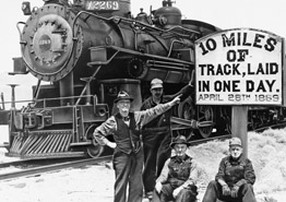
Building the railroad was tough, hard work. Weather conditions were especially tough in the mountains during winter, while in summer workers battled brutal heat.
The Central Pacific, building from the West, relied heavily on Chinese immigrants and Mormon workers. The Union Pacific, building from the East, used mostly Irish laborers who had served in the Army. Workers also faced raids from Native Americans, who recognized that the "Iron Horse" threatened their way of life.
Total construction took six years, finishing in 1869. The two crews met in Utah and celebrated with a golden spike. Crossing the country now took two days instead of six months!
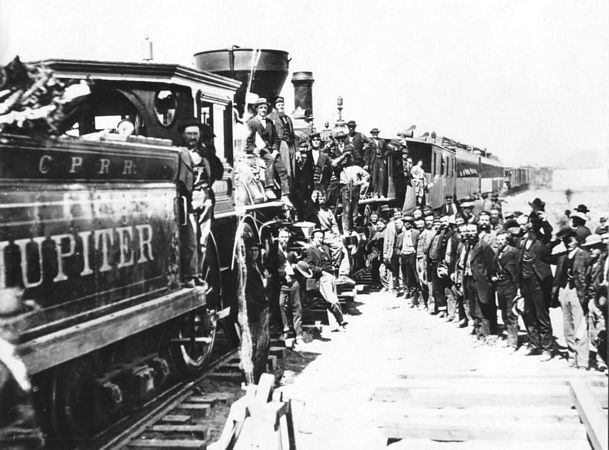
The transcontinental railroad connected the eastern and western United States by rail. Two companies built from opposite ends — the Central Pacific from the West and the Union Pacific from the East — meeting at Promontory Summit, Utah, in 1869.
The railroad transformed American life. The cost to travel cross-country dropped from nearly $1,000 to about $150. Businesses could ship goods quickly across the nation, helping the economy grow dramatically.
Construction was authorized by the Pacific Railroad Act of 1862, which provided government funding and land grants to make the project possible.
"The Transcontinental Railroad." Gale Elementary Online Collection, Gale, a Cengage Company, 2020. Gale In Context: Elementary, link.gale.com/apps/doc/XXUOGS604331601/ITKE?u=tel_s_tsla&sid=ITKE&xid=0d840b2f. Accessed 18 Feb. 2021.