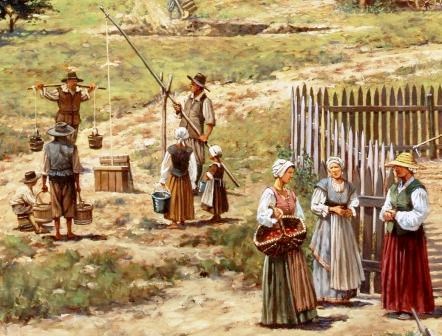
At this time, over two million people lived in the thirteen American colonies. Many people were farmers or planters who lived and worked on small farms of less than 200 acres. Only a small number were wealthy planters or merchants, and only about 2% of the people lived in small towns or cities. About 200,000 of these people were enslaved African Americans, most of whom worked in tobacco fields.
A small farmer living in this time was probably concerned mainly with surviving and trying to improve the lives of himself and his family. Whether a recent immigrant from England, Scotland, Ireland, or Germany, or a native Virginian, he probably hoped to improve his life by earning enough money to secure more land and nicer possessions.
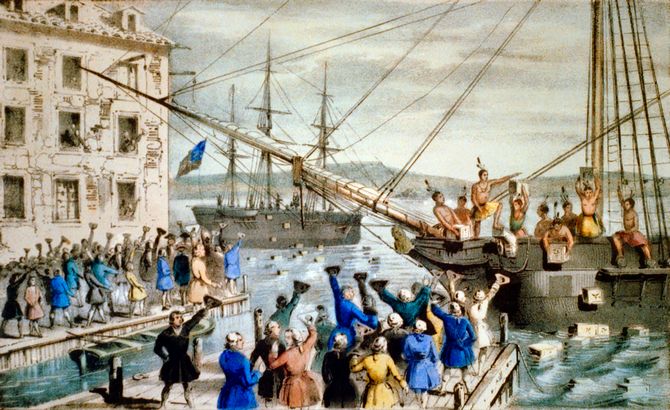
The people of Boston protested the Tea Act. They wanted to stop all British tea from entering the city. The governor of Boston decided to allow three ships to unload their tea. Boston would pay taxes on this tea.
Sixty Boston citizens dressed up like Native Americans to hide their identities from the British. The men charged the dock and forced their way onto the three ships. They were cheered on by large crowds of Boston citizens.
The protestors seized the tea from the ships. Then they dumped the tea into the ocean while the crowd watched. This destroyed the tea.
The tea had been worth a large sum of money. Its loss would hurt the British company. It showed the company and the British that the Tea Act would be fought by the colonies.
"Boston Tea Party." Gale Elementary Online Collection, Gale, a Cengage Company, 2020. Gale In Context: Elementary, link.gale.com/apps/doc/NSRXRH824522403/ITKE?u=tel_s_tsla&sid=ITKE&xid=0fac801d. Accessed 18 Feb. 2021.